 STACKMODE
Stackmode builds service business websites with local SEO structure, proof, booking paths, and real customer acquisition strategy.

What Was Built
Building a handyman repair website using Codex means more than asking AI for a homepage. In this session, StackModeChris used Codex 5.6 to shape a complete appliance repair website with service sections, conversion copy, local trust signals, visual explanations, and a direct path to book an estimate.
The finished example is Appliance King Repair, a Macon, Georgia service site built around the way real homeowners search. Instead of leading with vague design language, the site starts with repair problems people already understand: appliance repair, washer repair, dryer repair, refrigerator and freezer repair, dishwasher repair, and dryer-vent concerns.
Featured snippet answer: Codex can help build a handyman or appliance repair website quickly when the builder gives it a clear service strategy, local SEO targets, proof assets, customer objections, and conversion goals. The strongest result is not just a pretty homepage. It is a website that helps visitors understand the service and contact the business.
Why A Handyman Or Appliance Repair Website Needs More Than A Template
A template can make a repair business look presentable, but it usually does not explain why the customer should call now. Local service buyers are comparing urgency, trust, price comfort, location, and whether the company looks capable of solving their exact problem.
That is why a service business website needs pages and sections that map to real search intent. A person searching for dryer repair is not in the same mindset as a person researching a clogged dryer vent. A homeowner with a warm refrigerator needs a different reassurance than someone planning a non-urgent dishwasher repair.
- Show the main services before the visitor has to scroll too far.
- Use plain-language symptoms instead of only trade language.
- Make the phone number and estimate CTA visible on desktop and mobile.
- Add local signals so Google and customers understand the service area.
- Use visuals when the repair issue is hidden, technical, or hard to picture.
Video Walkthrough
Watch the full Codex 5.6 build session below, then use the written breakdown as a checklist for how to think through your own service business website.
If the player does not load, open the full video on YouTube.
Prefer YouTube? Open the handyman repair website build video directly.
Step-By-Step Codex Build Process
The best way to use Codex for a service website is to give it a business plan, not just a design request. The order matters because every design decision should support the customer path from problem to booked estimate.
1. Define the service lanes
Start with the jobs customers already search for, such as appliance repair, washer repair, dryer repair, refrigerator repair, and dishwasher repair.
2. Build the homepage around decisions
The homepage should answer what you fix, where you work, how to contact you, and why the visitor can trust you.
3. Add proof and visual clarity
Screenshots, icons, diagrams, repair-specific illustrations, and review language make the business feel real faster.
4. Create SEO-ready sections
Each service section should use natural keywords, symptom language, internal links, and headings that match local search intent.
5. Test mobile conversion
Most local service traffic is mobile. The phone number, booking button, and service navigation have to be easy to use on a small screen.
6. Publish and keep improving
After launch, use Google Search Console, call data, and customer questions to decide which pages need more depth.
Common Mistakes Business Owners Make
Most business owners do not fail because they used AI. They fail because they use AI to create a generic page that does not match the buyer, the market, or the service call. Codex can move fast, but speed only helps when the direction is correct.
- Using a homepage headline like "quality service you can trust" without naming the actual repair categories.
- Hiding the phone number behind a menu on mobile.
- Writing one thin services page instead of specific pages for the jobs people search.
- Using stock photos that do not match the actual work or brand.
- Skipping metadata, sitemap coverage, image alt text, and internal links.
- Launching without checking whether forms, booking links, and calls work.
Appliance King Case Study
Appliance King works because the site feels like a real local repair business instead of a blank brochure. The navigation separates service categories, the phone number is prominent, and the homepage introduces the jobs people care about before asking them to dig.
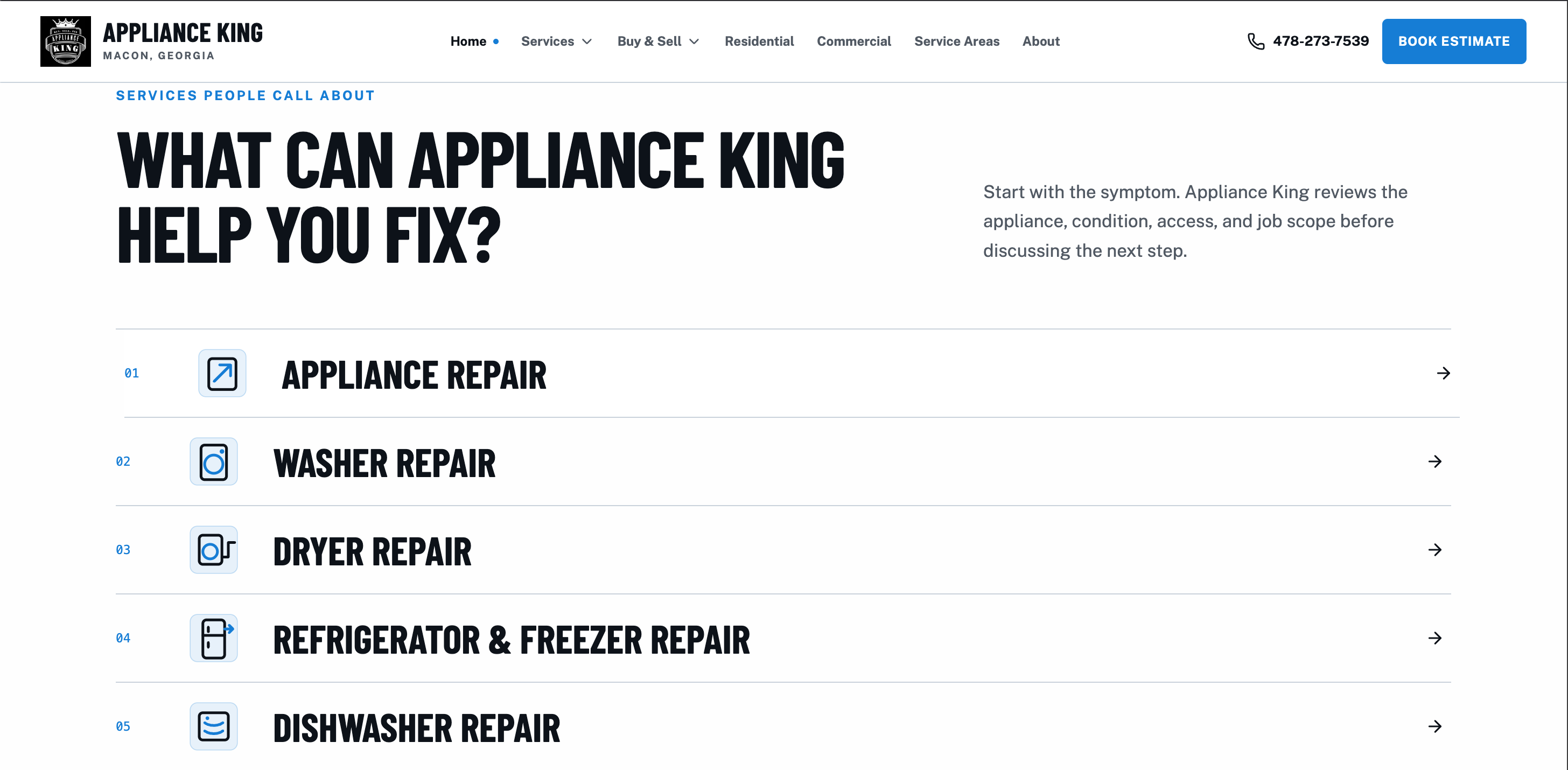
This is also useful for SEO. Google needs clear page context, but the customer needs it too. When a service business names the work clearly, the same structure helps search engines, AI overviews, and actual homeowners understand the page.
If you are comparing this to your own site, look at the first screen and ask one question: can a cold visitor tell what you do, where you do it, and how to contact you in under ten seconds?
How The Dryer Animation Improves Trust
The dryer-vent visual matters because the problem is usually hidden behind a wall, a machine, or an exterior exhaust route. A clear animation turns an invisible issue into something the homeowner can understand before they call.
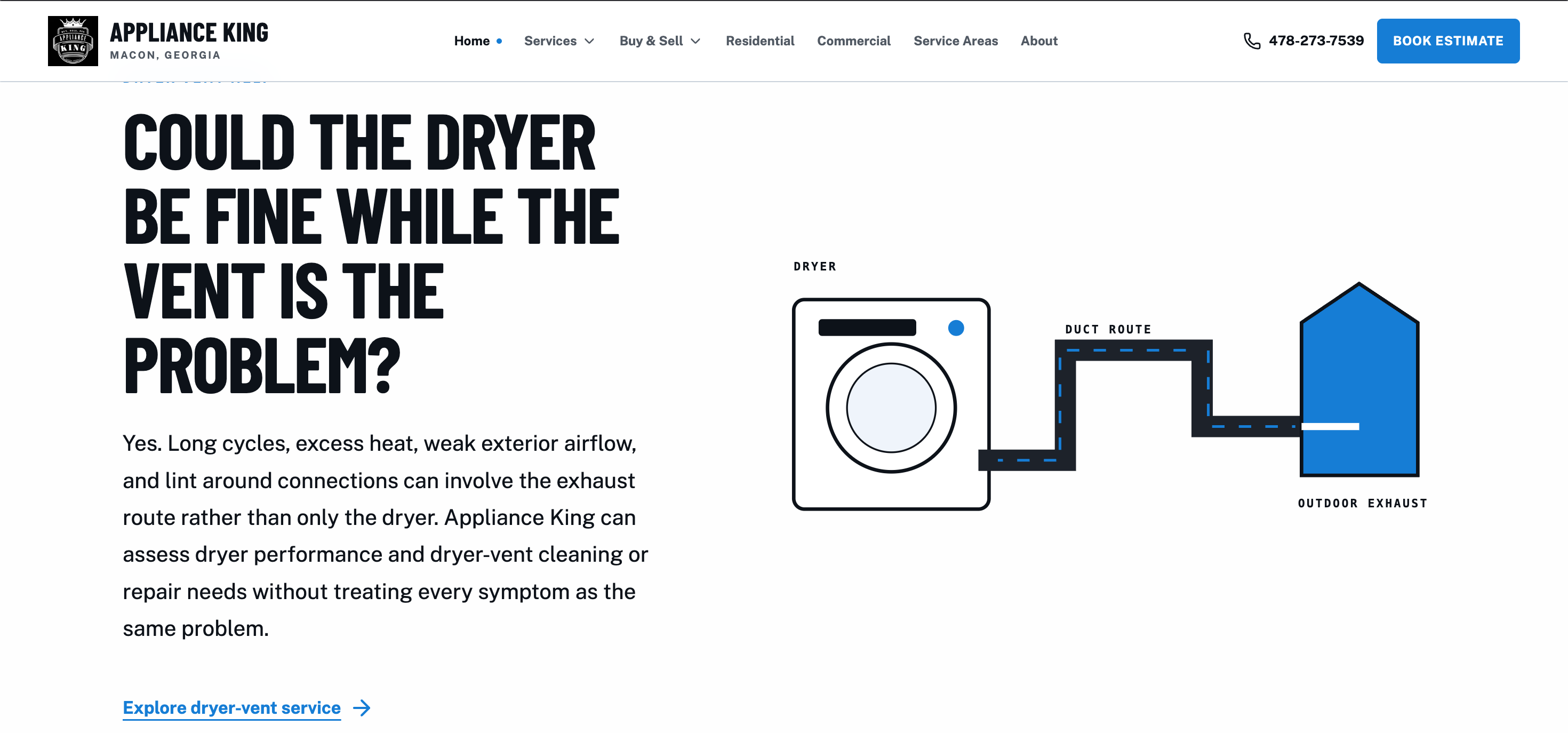
Dryer safety is not just a design angle. The U.S. Fire Administration notes that failure to clean was the leading factor contributing to ignition in clothes dryer fires from 2018 to 2020. That makes dryer-vent education a real trust builder when it is handled clearly and responsibly.
The article and website should not scare people with hype. The better move is practical: show the system, explain the symptoms, cite a credible source, and give the visitor a clean next step. For technical context on proper dryer exhaust routing, the Building America Solution Center also explains why dryer exhaust should vent outdoors through approved ducting.
SEO Lessons From The Build
The SEO lesson from this Codex build is simple: AI can create the page faster, but Google still rewards useful structure. The page has to answer the actual service question, support local intent, and make the business entity easier to understand.
Use service-specific headings
Headings like dryer repair, washer repair, and refrigerator repair are clearer than broad copy about home services.
Write for customer symptoms
People search for what they notice: long dry times, warm fridge, leaking dishwasher, loud washer, or a dryer vent that may be blocked.
Connect articles to money pages
A tutorial article should point readers into website services, custom website strategy, and the live client example.
Make images indexable and useful
Screenshots need descriptive filenames, alt text, captions, and non-stretched sizing so they help humans and search engines.
FAQ
Can Codex build a real handyman or appliance repair website?
Yes. Codex can help build a real service business website when the operator gives it the right business details, service structure, proof, local SEO targets, and conversion requirements. The tool is strongest when guided by a clear strategy instead of being treated like a generic template generator.
What should an appliance repair website include?
An appliance repair website should include clear service categories, phone and booking CTAs, local trust signals, service area content, symptom-based explanations, images or diagrams, reviews, and SEO metadata. The page should help visitors decide whether to call before they compare three other companies.
Why does a dryer-vent animation help a repair website convert?
A dryer-vent animation helps because it explains a hidden problem visually. Many homeowners cannot see the duct route behind the dryer, so a simple diagram makes the risk and service easier to understand. That creates trust before the visitor reaches the booking button.
Is AI enough to build a website that ranks?
AI is not enough by itself. Rankings still depend on search intent, useful content, technical SEO, internal links, local relevance, crawlability, and page quality. Codex can speed up implementation, but the strategy must come from someone who understands the customer and the market.
What is the fastest way to improve a local service website?
The fastest improvement is usually cleaning up the homepage offer, adding specific service pages, making the phone and booking path obvious, improving local SEO metadata, and adding proof. A beautiful site that hides the call button or uses vague service copy will still lose leads.
Next Steps
If you run a handyman, appliance repair, home service, or local trade business, start by auditing the first screen of your website. Your visitor should instantly know what you fix, where you work, why they can trust you, and how to book.
Then build deeper service pages around your highest-value jobs. For many repair businesses, that means separating appliance repair, washer repair, dryer repair, refrigerator repair, dishwasher repair, and dryer-vent service instead of forcing every visitor through one generic page.
Want to see the finished example? Visit Appliance King Repair. If you want Stackmode to build this kind of website for your own business, book the website call and bring your services, city, photos, reviews, and best offers.
Need A Service Website That Can Pull Calls?
Pick one clean next action instead of bouncing around the site.
Websites & Ads
Websites & Ads Design/Management
Book the website and Meta ads lane for design, SEO structure, conversion flow, and ongoing management.
Trading
1-on-1 Trading Mentorship $100/hour
Direct educational mentorship with StackmodeChris on planning, risk, execution, and review.
Academy
Join The Academy $50/month
Get the ongoing business, marketing, technology, and trading education path inside the full Stackmode Academy.