
Join Stackmode Trading School and get the exact framework our traders use to navigate bull market cycles — including level-based entries, profit-taking rules, and risk management that protects your capital when others are gambling theirs.
Quick Answer: What Is the 2026 Crypto Cycle?
The 2026 crypto cycle is the active phase of Bitcoin's fourth four-year halving cycle, which began with the April 2024 halving. Based on the previous three cycles, the 12–18 months following a halving have historically produced the strongest price appreciation in the entire cycle — placing the most active bull phase squarely in the 2025–2026 window.
This does not mean it is guaranteed to happen. It means the historical setup is in place, and traders who miss the early part of each cycle typically find themselves chasing price near the top. The time to plan your positioning is now — before the move, not during it.
Watch: Don't Miss This 2026 Crypto Cycle (Full Breakdown)
In this video, I break down exactly why the 2026 crypto cycle is one of the most important windows for crypto investors, what the historical halving data shows, and how to think about positioning without gambling your entire account on a single move.
What Is the Crypto Cycle?
The crypto cycle refers to the recurring pattern of boom and bust that has characterized Bitcoin and the broader crypto market since Bitcoin's inception. This pattern is driven primarily by Bitcoin's programmatic supply reduction mechanism — the halving.
Every four years, Bitcoin's block reward is cut in half. This reduces the rate at which new Bitcoin enters the market, creating a supply shock that, when met with stable or growing demand, historically drives prices significantly higher. After the peak, a period of excessive speculation, over-leverage, and eventual deleveraging causes a significant correction — the "crypto winter."
The four phases of a crypto cycle:
- Accumulation: After a bear market bottom, price is depressed, media attention is low, and long-term participants quietly accumulate. Most retail investors are not paying attention.
- Bull Run: Post-halving supply shock meets growing demand. Bitcoin leads the move higher, followed by Ethereum and then altcoins. Media coverage increases, retail FOMO accelerates, and prices overshoot fair value.
- Peak: Euphoria is at maximum. Price reaches a generational high. Smart money begins distributing to retail buyers. News coverage is overwhelmingly positive, which is historically a contrarian warning sign.
- Bear Market: Price corrects 70–90% from the peak over 12–24 months. Projects fail, companies go bankrupt, and most retail participants who bought near the top hold losing positions for years.
Bitcoin Halving 2024: What It Means for the 2026 Cycle
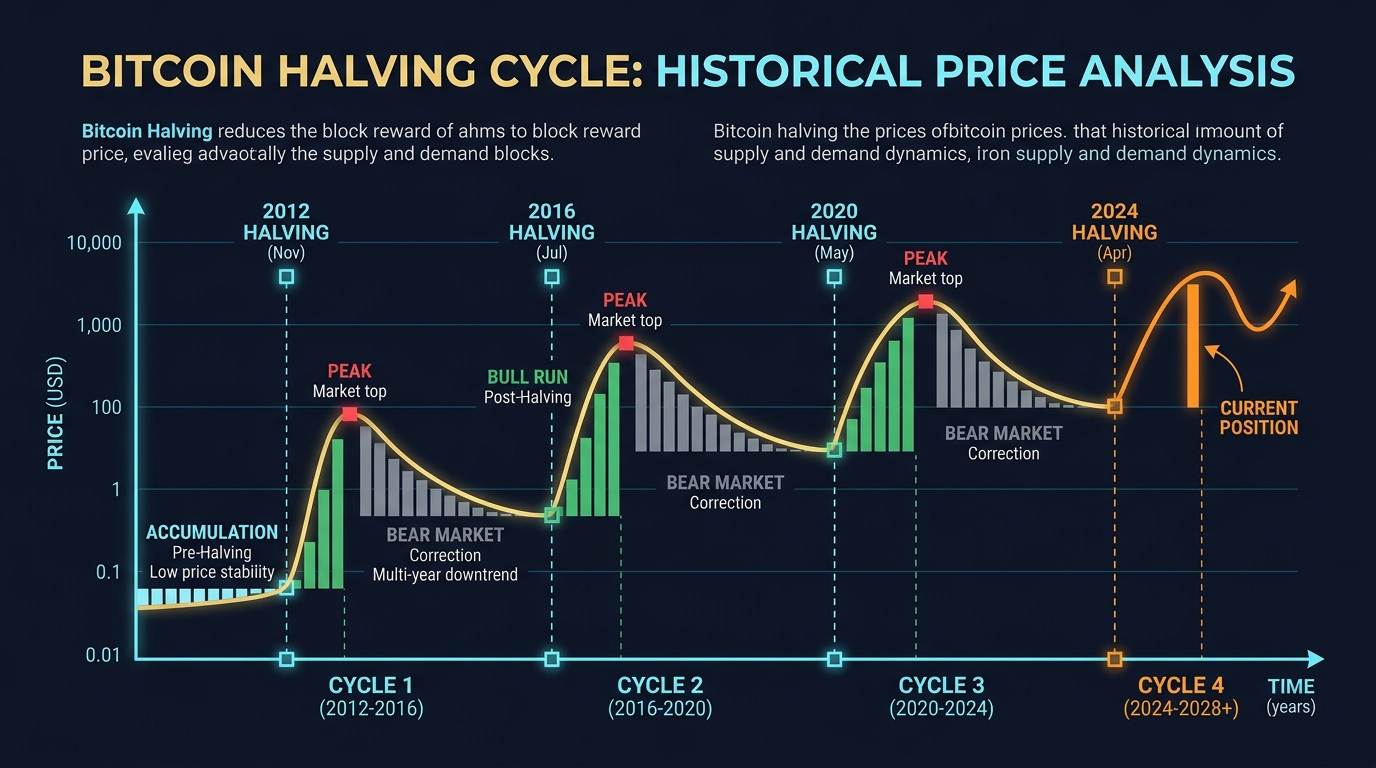
The April 2024 Bitcoin halving reduced the block reward from 6.25 BTC to 3.125 BTC per block. This means approximately 450 BTC per day was removed from the daily supply entering circulation — cut in half from roughly 900 BTC per day.
Looking at the previous three cycles for context:
- Cycle 1 (2012 Halving): Bitcoin peaked approximately 12 months after the halving, going from around $12 to $1,100 — a gain of roughly 9,000%.
- Cycle 2 (2016 Halving): Bitcoin peaked approximately 17 months after the halving, going from around $650 to nearly $20,000 — a gain of roughly 3,000%.
- Cycle 3 (2020 Halving): Bitcoin peaked approximately 18 months after the halving, going from around $9,000 to $69,000 — a gain of roughly 665%.
The percentage gains have diminished each cycle as Bitcoin's market capitalization has grown — this is expected and mathematically inevitable. But the directional pattern has remained consistent. Cycle 4 (2024) places the historical peak window in late 2025 to early 2026.
Important Context:
Past halving cycles are historical data, not a proven formula. Each cycle occurs in a different macro environment with different regulatory conditions, different institutional participation levels, and different global liquidity conditions. Use cycle data as context, not as a trading signal.
What Historically Happens in Cycle Year 2 Post-Halving
"Cycle Year 2" refers to the 12–24 month window following a Bitcoin halving. In all three previous cycles, this was the period of maximum price appreciation — and also the period of maximum media hype, retail FOMO, and eventual distribution.
What the historical data shows for cycle year 2:
- Bitcoin leads: BTC typically makes its highest gains in the first half of cycle year 2, as institutional and early retail capital flows into the most liquid and trusted crypto asset.
- Ethereum accelerates: Once Bitcoin establishes a strong uptrend and makes or approaches new all-time highs, Ethereum (and other large-cap altcoins) begin to outperform Bitcoin on a percentage basis.
- Altcoin season follows: Smaller-cap altcoins see their most extreme gains in the later phase of cycle year 2 — but they also experience the sharpest corrections. The later the capital arrives in altcoins, the more dangerous the position.
- The top is invisible in real-time: In every previous cycle, the market peak was only obvious in hindsight. During the peak, news was overwhelmingly positive, new price targets were being set daily, and mainstream adoption narratives were at their loudest. This is when professional traders and early investors are selling — not buying.
Altcoin Season 2026: When and How It Has Historically Played Out
Altcoin season is the phase of a crypto cycle where many altcoins (non-Bitcoin cryptocurrencies) outperform Bitcoin percentage-wise. It has occurred in every previous cycle — but its timing, depth, and which coins outperform has varied significantly.
Historical altcoin season patterns to understand:
- 2017 Altcoin Season: Ethereum led, followed by a wave of ICO tokens. Many coins saw 10x to 100x gains before losing 95%+ in 2018.
- 2020–2021 Altcoin Season: DeFi led first, then NFT-adjacent projects, then "Layer 1 killers," then memecoins in the final phase. Late-cycle altcoins experienced some of the most extreme gains — and the most extreme losses.
- Key signal to watch: Bitcoin dominance (the percentage of total crypto market cap held by BTC) falling below 40–45% has historically correlated with altcoin season beginning. Monitor this metric, not social media sentiment.
For guidance on navigating higher-risk crypto positions, see our guide on how to grow a small crypto futures account safely.
How to Position for the 2026 Crypto Cycle
There is no single correct way to position for a crypto cycle. The right approach depends on your risk tolerance, time horizon, and capital. Here is a structured framework:
- Establish your base in Bitcoin and Ethereum. These are the highest liquidity, most regulated, and most institutionally-held assets in crypto. Any cycle positioning that does not start here is disproportionately speculative.
- Use dollar-cost averaging (DCA) rather than all-in entries. Splitting your planned position across 4–8 purchases over weeks or months removes the risk of buying a local top and averaging into a better overall cost basis.
- Set profit targets in advance — not during the move. Decide at what price or portfolio value you will take profits before the cycle peaks. Traders who plan exits during euphoria almost always get greedy and hold too long.
- Size altcoin positions much smaller than Bitcoin. Altcoins can outperform BTC by 3–10x in a cycle — but they also carry far higher risk of going to zero in a bear market. A portfolio that is 70% BTC and 30% selected altcoins is more resilient than one that is 80% altcoins by count.
- Keep a cash reserve. Maintaining 20–30% of your intended crypto allocation in cash at all times lets you add to positions during cycle corrections without needing to sell other holdings.
What to Avoid in the 2026 Crypto Cycle
- Using leverage on spot holdings. Leverage amplifies both gains and losses. In a bull market, overleveraged positions get liquidated on normal corrections before the real move happens. Never use leverage on your long-term crypto holdings.
- Holding through the peak because of FOMO. Every previous cycle has ended with participants convinced the rally would continue indefinitely. Having pre-planned profit-taking levels removes the emotional decision from the peak moment.
- Buying memecoins late in the cycle. Memecoins have historically delivered the biggest gains in the final weeks of a cycle — and the most devastating losses. Late-cycle memecoin buying is high-risk speculation, not investing.
- Putting money you cannot afford to lose into crypto. Every crypto asset, including Bitcoin, has experienced 50–90% drawdowns. Never allocate money needed for expenses, emergencies, or near-term obligations to any volatile asset class.
See our guide on the realities of trading memecoins and what most people learn too late.
Honest Limitations: What This Article Cannot Tell You
Important Risk Disclosures
- Past cycles do not guarantee future results. The Bitcoin halving cycle pattern is based on three data points — 2012, 2016, and 2020. Three data points is not a statistically proven law. Cycle 4 (2024–2026) could behave very differently due to macro conditions, regulation, or structural market changes.
- Timing the cycle is nearly impossible. Professional traders and institutional funds with far more resources than individual investors have been wrong about cycle timing. Do not make large financial decisions based on cycle timing assumptions alone.
- This article does not predict any specific price. Nothing in this article constitutes a price target, a prediction of when or how high Bitcoin or any other asset will trade. All historical references are for educational context only.
- This article is for educational purposes only and is not financial advice. Cryptocurrency investing involves significant risk of total capital loss. Consult a licensed financial advisor before making any investment decisions. Only invest what you can afford to lose entirely.
FAQ: The 2026 Crypto Cycle
What is the 2026 crypto cycle?
The 2026 crypto cycle refers to the current phase of the Bitcoin 4-year halving cycle that began with the April 2024 halving event. Historically, the 12–18 months following a Bitcoin halving have produced the strongest price appreciation in the cycle, which puts the most active phase of Cycle 4 in the 2025–2026 window. However, past cycles do not guarantee future performance.
When does Bitcoin halving happen and why does it matter?
Bitcoin halving occurs approximately every four years (every 210,000 blocks). At each halving, the reward paid to Bitcoin miners is cut in half, which reduces the rate at which new Bitcoin enters circulation. The April 2024 halving cut the block reward from 6.25 BTC to 3.125 BTC. Historically, this supply shock has preceded significant price appreciation in the 12–18 months following each event.
Will there be an altcoin season in 2026?
Based on the previous three Bitcoin halving cycles, altcoin season — where smaller cryptocurrencies outperform Bitcoin percentage-wise — has historically occurred after Bitcoin establishes new all-time highs. Capital tends to rotate from Bitcoin into Ethereum and then into smaller-cap altcoins. This pattern has repeated in 2013, 2017, and 2021, but there is no guarantee it repeats identically in 2026.
How long does a crypto bull market typically last?
Based on the three previous Bitcoin halving cycles, the post-halving bull market phase has lasted approximately 12–18 months from the halving date before a major correction or bear market begins. Cycle 1 (2012–2013) lasted about 12 months. Cycle 2 (2016–2017) lasted about 18 months. Cycle 3 (2020–2021) lasted about 16 months. Cycle 4 (2024–2026) is currently in progress.
What is the best strategy for the 2026 crypto cycle?
The best strategies for navigating a crypto cycle include: dollar-cost averaging into Bitcoin and Ethereum (rather than timing a single entry), setting clear profit-taking targets before the trade (not after), keeping position sizes small enough that a 50–80% correction would not devastate your portfolio, and maintaining a cash reserve to buy corrections. Avoid using leverage in spot holdings, avoid memecoins without a clear edge, and have a pre-planned exit strategy before the cycle peaks.
What happens after the 2026 crypto cycle peaks?
Based on historical patterns, after each crypto cycle peak, Bitcoin and most altcoins experience a significant correction ranging from 70–90% from peak to trough over 12–24 months. The bear market phase that followed previous bull runs (2014–2015, 2018, 2022) tested the resolve of all participants who did not take profits near the peak. Planning your exit before the peak is critical — it is nearly impossible to time the exact top.
Should I buy Bitcoin or altcoins for the 2026 cycle?
Bitcoin has the highest liquidity, the clearest halving narrative, and the lowest relative risk within the crypto asset class. For most investors, Bitcoin is the safer position in any cycle. Altcoins can outperform Bitcoin percentage-wise during altcoin season, but they also carry higher volatility and a much higher risk of permanent capital loss — especially lower-cap altcoins that may not recover from bear markets. Any altcoin allocation should be sized much smaller than your Bitcoin position.
Can the 2026 crypto cycle fail to materialize?
Yes. The 2026 crypto cycle playing out like previous cycles is a historical pattern, not a law of nature. Factors that could disrupt the cycle include: major regulatory crackdowns on crypto exchanges or stablecoins, a broader global financial crisis that forces liquidation of risk assets, a significant security or protocol failure in major blockchains, or macro conditions that remove risk appetite from all speculative assets. Always plan for the possibility that this cycle behaves differently from prior ones.
Best-Fit Framework: What This Topic Can and Cannot Tell You
Don't Miss This 2026 Crypto Cycle is best understood as an educational framework: define the decision, compare the available choices, verify current evidence, and keep the downside explicit before acting.
| Option or lens | Best for | Honest limit |
|---|---|---|
| Definition | Clarifying what the topic actually means | A definition does not predict a market outcome. |
| Process | Turning the idea into repeatable research steps | A process still depends on execution and current conditions. |
| Risk check | Sizing uncertainty and writing invalidation rules | Risk controls reduce exposure; they do not remove loss. |
Research Checklist and Related Stackmode Lessons
Use primary sources for current rules and the related Stackmode pages for connected market context. The links are learning paths, not promises that a result will transfer from one market or person to another.
Visual Study Opportunities
These are useful visual checkpoints for a future revision or companion graphic. They make the explanation easier to scan without presenting an unverified chart, number, or performance claim as proof.
- 1. A one-sentence definition card with the key term highlighted.
- 2. A labeled process diagram showing research before execution.
- 3. A comparison table with the same criteria across alternatives.
- 4. A before-and-after example that clearly labels assumptions.
- 5. A timeline showing which facts are current and which are historical.
- 6. A risk ladder from low complexity to high complexity.
- 7. A checklist for source, date, cost, liquidity, and invalidation.
- 8. A worked example using hypothetical values rather than a promise.
- 9. A common-mistakes graphic with the correction beside each mistake.
- 10. A final decision tree showing when to pause and verify more evidence.
Expanded FAQ
What is the main idea of this article?
The main idea is to understand don't miss this 2026 crypto cycle as a process with defined assumptions, risks, and verification steps rather than as a guaranteed outcome.
Who is this article for?
It is for readers who want an educational framework before making a market, trading, or investing decision.
What should a beginner do first?
Start with the definition, identify the instrument or market involved, and write down the risk before thinking about an entry or action.
What information should be verified?
Verify the product rules, current data, costs, timing, liquidity, source date, and any claim that could change the decision.
What is the biggest mistake to avoid?
The biggest mistake is treating an educational explanation as a promise and skipping independent risk checks.
How does risk management fit in?
Risk management sets the position size, invalidation point, maximum loss, and review process before execution.
Can this approach guarantee a profit?
No. Markets are uncertain, and no framework can guarantee a profit or remove loss risk.
How current is this information?
Market rules, prices, products, and policy can change, so check the dated primary source before acting.
Should this replace professional advice?
No. It is general education, not personalized financial, tax, legal, or investment advice.
How should readers compare alternatives?
Compare the same criteria: purpose, issuer, liquidity, costs, volatility, custody, time horizon, and honest limitations.
What should be written in a trading plan?
Record the thesis, setup, entry condition, invalidation, size, maximum loss, exit logic, and review date.
Why do source dates matter?
A dated source shows when a rule, number, or statement was true and helps expose stale or unsupported claims.
Conclusion: Use the Framework, Then Verify the Decision
Don't Miss This 2026 Crypto Cycle is best understood as an educational framework: define the decision, compare the available choices, verify current evidence, and keep the downside explicit before acting. The useful takeaway is not a prediction. It is a repeatable process: define the topic, compare the available choices, verify current sources, size risk conservatively, and record what would change your mind.
Stackmode provides educational market context, not guaranteed returns or personalized financial advice. Recheck current rules, prices, liquidity, and tax implications before acting.
Free trading playbook
Build the plan before you place the trade.
Get the Stackmode playbook for pullbacks, risk limits, entries, exits, and trade review. It is a practical first step before you sign up for the Trading School.
- • Define the setup before entry
- • Mark invalidation and risk
- • Stop chasing moves
- • Review decisions, not just results
Opens the external Stackmode playbook page. Education only.
Trading Books
Keep Learning After The Article
Pick the book that matches the skill you want to practice next. Each one gives you a focused framework to work through after this article, with Amazon paperback and eBook options available.
Recommended starting point
Neuro Trading
Master the psychology of trading.
- Why 90% of traders lose and how to think like the 10%
- Emotional discipline techniques used by stronger traders
- A mindset framework built for long-term execution
eBook
$9.99
Paperback
$19.99
Audiobook
$9.99

Before The Hype
How to spot opportunities before they go viral.
- Learn the asset stacking strategy for long-term wealth
- Find high-signal trends before they become crowded
- Think earlier instead of chasing late momentum
eBook
$9.99
Paperback
$19.99
Audiobook
$9.99
Freedom Money
Understand Bitcoin and what it does.
- A cleaner beginner path into Bitcoin
- Protect and grow money with stronger awareness
- Build conviction before you move capital
eBook
$9.99
Paperback
$19.99
Audiobook
$9.99
Trade This Cycle With a Plan, Not Emotion
Pick one clean next action instead of bouncing around the site.
START HERE
Stackmode Trading School
Join the school for live classes, market review, organized lessons, StackFinder access, and member support. $499/year — StackFinder included.
Best value
StackMode Trading School
Live group sessions, stock and crypto market review, organized video lessons, StackFinder access, and a Halal spot-trading framework. $499/year.
Live class plan
Live Group Sessions Included
Bring questions, review charts, and learn the same repeatable process with students moving through the class plan together.
StackFinder
StackFinder Member Tools
AI scanner, personal watchlist, daily stock and crypto setups, dashboards, and trade-prep tools are included with the group.
Education and risk disclosure
Stackmode provides education, tools, examples, and market commentary only. Nothing on this site is personalized financial, investment, tax, or legal advice, and no result, trade recap, screenshot, testimonial, alert, or example is a promise of future performance. Trading and investing involve substantial risk of loss, including the possible loss of capital. You are responsible for your own decisions, position size, broker selection, tax treatment, and compliance with the laws and rules that apply in your location.
Read the full risk disclosure