
Join Stackmode Trading School and learn the exact position sizing framework and compounding strategy we use to grow accounts — without the liquidations.
Quick Answer: How To Grow a Small Crypto Futures Account
To grow a small crypto futures account, you need three non-negotiables: strict position sizing (never risk more than 1–2% of your account per trade), controlled leverage (3x–10x maximum for beginners), and a compounding plan that lets small, consistent wins build on each other over time.
The single biggest reason small accounts get blown up is not a lack of chart-reading skill — it is trading too large too fast. Until you master the math of position sizing, no strategy in the world will save you.
Watch the Step-By-Step Guide: Growing a Small Crypto Futures Account
In this video, I break down the exact step-by-step process I use to manage and grow a small crypto futures account — from how I size positions and set leverage to the mindset shift that makes compounding possible.
Why Small Crypto Futures Accounts Blow Up (The Real Reason)
Every week, thousands of traders open a crypto futures account with $200–$500, turn on 50x leverage, and lose everything within days. This is not bad luck — it is math.
At 50x leverage, a move of just 2% against your position will liquidate your entire account. In crypto, 2% moves happen multiple times per day. The problem is never the market; it is the leverage applied to an undersized account with no risk management.
The four most common small-account killers in crypto futures:
- Overleveraging: Using 20x, 50x, or 125x leverage with no strategy for how much capital is actually at risk per trade.
- No Stop-Loss Discipline: Entering trades without a defined exit point and holding losing positions, hoping the market reverses.
- Revenge Trading: After a loss, immediately increasing position size to "make it back" — which compounds losses rather than recovering them.
- FOMO Chasing: Entering a trade after a large move has already occurred, buying the top of a pump or shorting the bottom of a dump.
Understanding what kills small accounts is the first step toward making sure none of these patterns happen to you.
Position Sizing: The #1 Rule for Growing Any Futures Account
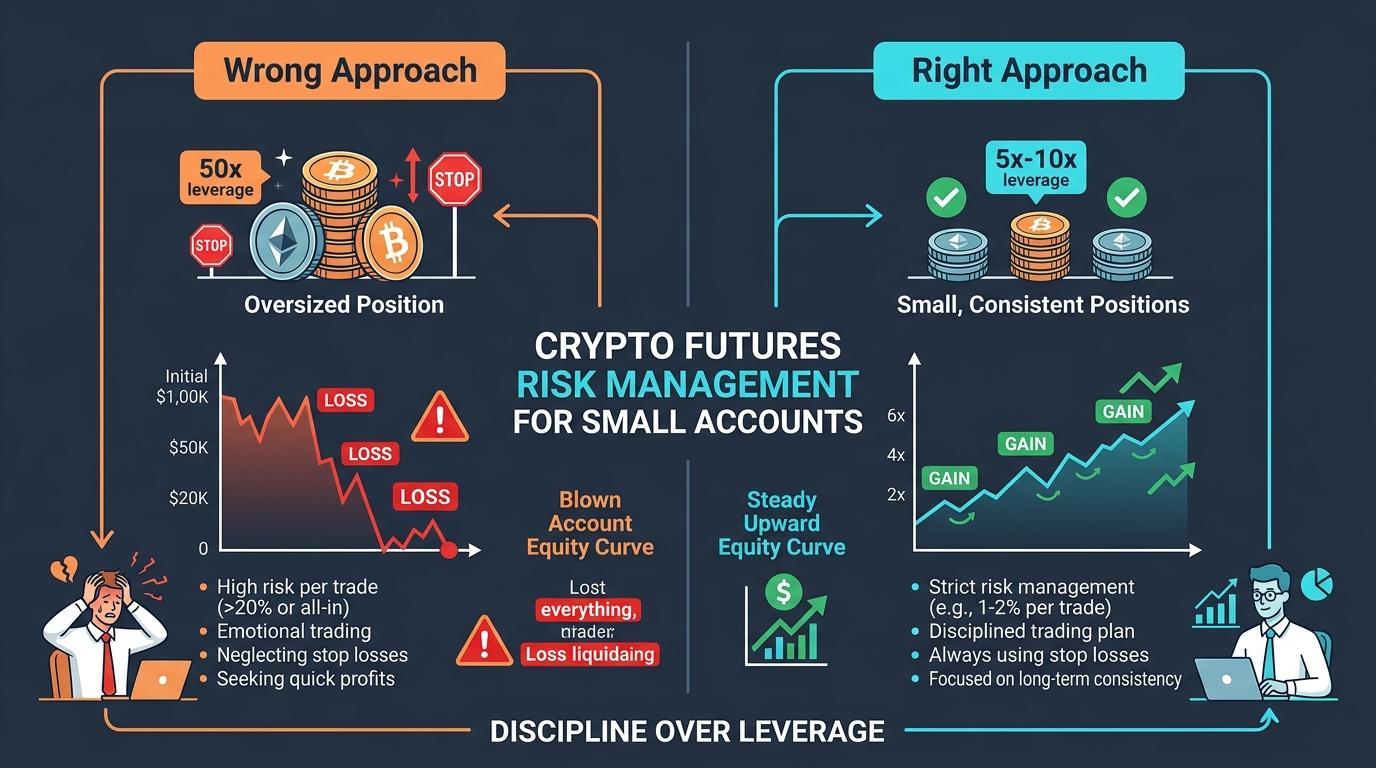
Position sizing is the practice of calculating exactly how much of your account is at risk on each trade — expressed as a percentage. The formula is:
Position Size Formula:
Dollar Risk Per Trade = Account Balance × Risk Percentage (1–2%)
Position Size = Dollar Risk ÷ (Entry Price − Stop-Loss Price)
Example: Your account has $500. You risk 1% per trade ($5). Your entry on BTC is $60,000 and your stop-loss is at $59,400 (a $600 difference). Your position size is $5 ÷ $600 = 0.0083 BTC. That is your maximum position regardless of what leverage the exchange allows.
Notice that this formula caps your risk at $5 no matter what — that is the entire point. You decide your risk first; then you let the math tell you how large the position should be. Never do it the other way around.
Consistent 1–2% risk per trade means you can survive 10, 20, even 30 losing trades in a row without blowing your account. That kind of durability is what gives your edge time to play out.
Leverage Discipline for Small Crypto Futures Accounts
Leverage is a tool — and like any tool, it can build or destroy depending on how it is used. For a small futures account, the goal of leverage is not to get rich on one trade. The goal is to allow you to trade standard-sized positions without needing enormous capital.
Here is a practical leverage framework for small accounts:
| Leverage Level | Liquidation Move Against You | Recommendation |
|---|---|---|
| 3x–5x | ~20–33% move against you | ✅ Ideal for beginners |
| 5x–10x | ~10–20% move against you | ⚠️ Intermediate, use stop-loss |
| 10x–25x | ~4–10% move against you | ⚠️ Advanced only, tight stops required |
| 25x–125x | <4% move liquidates you | ❌ Avoid — small accounts cannot survive normal volatility |
Most beginners gravitate toward high leverage because they see 100x returns advertised on social media. What is never shown is the other 99% of accounts that were wiped out in the same timeframe. Keep your leverage low until you have at least 3–6 months of consistent positive results.
The Compounding Plan That Actually Works for Small Accounts
Compounding is the process of reinvesting your profits so that your account grows exponentially rather than linearly. The math of compounding is one of the most powerful forces in finance — but it requires patience and consistency to work.
Here is what compounding looks like with disciplined 1–2% risk and a 55% win rate on 1:2 risk-to-reward trades:
- Month 1: Starting balance $500 → consistent small gains → end balance approximately $600–$650.
- Month 3: Balance grows to $800–$1,000 as position sizes scale naturally with account size.
- Month 6: Account reaches $1,500–$2,000 with the same discipline applied.
These numbers are conservative estimates and are not guarantees — but they illustrate why consistent, small gains that compound over time outperform any single "all-in" bet. The trader who turns $500 into $2,000 in six months through discipline will reach $10,000 in another six months. The trader who tries to turn $500 into $10,000 in one month will almost always hit zero first.
The compounding rule for small accounts is simple: never withdraw profits until your account reaches at least 4x your starting balance. Let the math work for you.
Step-By-Step Process to Grow Your Small Crypto Futures Account
Here is the exact process to follow every week you are trading a small futures account:
- Step 1 — Define your risk budget for the week. Decide your maximum weekly drawdown (e.g., 5–10% of account). If you hit that limit, stop trading for the rest of the week. This prevents one bad day from destroying months of progress.
- Step 2 — Only trade with the trend on the higher timeframe. Check the Daily chart direction on BTC or your target asset. Take only long setups in an uptrend and short setups in a downtrend. Never trade against the macro structure on a small account.
- Step 3 — Wait for a key zone and a trigger. Do not chase price. Mark your support and resistance zones on the H4 chart and wait for price to arrive at a zone before looking for an entry signal on the H1 or M15.
- Step 4 — Calculate your position size before entering. Use the formula: Dollar Risk ÷ (Entry − Stop-Loss) = Position Size. Set your stop-loss at the same time you set your entry. Never move your stop-loss to avoid a loss.
- Step 5 — Take profits at 1:2 or better. Close at least 50% of your position at your first target (2x your risk). Move stop-loss to breakeven on the remainder. This locks in profit on every winning trade.
- Step 6 — Review every trade in a journal. Record entry, exit, reason for the trade, and what you learned. The traders who journal are the traders who improve fastest. No exceptions.
Repeat this process for 90 days without deviation. If you cannot follow it for 90 days, you are not ready to grow a live account. See our full guide on why journaling your trades is non-negotiable.
Honest Limitations: What This Guide Cannot Promise You
Important Risk Disclosures
- Crypto futures are extremely high-risk instruments. Unlike spot trading, futures contracts involve leverage, funding rates, liquidation risk, and potential losses that can exceed your initial deposit on some exchange structures. Beginners should paper-trade for at least 30–60 days before trading live capital.
- The compounding projections in this article are illustrative only. Actual results depend entirely on your execution, discipline, market conditions, and trading edge. These numbers do not represent guaranteed outcomes or typical results.
- Exchange risk is real. Crypto exchanges can freeze withdrawals, get hacked, or go insolvent. Never keep more funds on a futures exchange than you are actively using for trading. Keep the majority of your capital in self-custody.
- This article is for educational purposes only and is not financial advice. Crypto futures trading involves significant risk of total capital loss. Only trade with money you can afford to lose entirely.
FAQ: Growing a Small Crypto Futures Account
How much money do you need to start a crypto futures account?
Many exchanges allow you to start a crypto futures account with as little as $100–$500. However, having too little capital makes proper position sizing nearly impossible. A starting balance of $500–$2,000 gives you enough room to risk 1–2% per trade without your position sizes becoming negligibly small or emotionally impractical.
What leverage should a small crypto futures account use?
For small accounts, 3x–10x leverage is the responsible range. Higher leverage — such as 25x, 50x, or 125x — drastically increases the chance of liquidation on any normal market pullback. Low leverage keeps you in the game long enough to compound your returns over time.
How do you grow a small crypto futures account fast?
The fastest sustainable path is not through high leverage — it is through consistent risk management and compounding small wins. Risk 1–2% per trade, maintain a minimum 1:2 risk-to-reward ratio, and let profits compound over weeks and months rather than trying to double your account in a single trade.
What is position sizing in crypto futures?
Position sizing is the process of calculating exactly how large your trade should be so that if your stop-loss is hit, you only lose a predetermined percentage of your total account. For example, if your account is $1,000 and you risk 1% per trade, your maximum loss per trade is $10 regardless of leverage.
Should I trade long and short positions as a beginner?
Beginners should focus primarily on long setups that align with the higher-timeframe trend. Shorting in crypto is possible but requires more experience, as crypto assets can experience violent short squeezes. Master trend-following longs before adding short strategies to your playbook.
How long does it take to grow a small crypto futures account?
With disciplined 1–2% risk per trade and consistent positive expectancy, a small account can realistically double in 3–6 months. Attempting to grow faster almost always leads to oversizing, emotional trading, and account blowups. Slow and compounding beats fast and reckless every time.
Best-Fit Framework: What This Topic Can and Cannot Tell You
How to Grow a Small Crypto Futures Account is best understood as an educational framework: define the decision, compare the available choices, verify current evidence, and keep the downside explicit before acting.
| Option or lens | Best for | Honest limit |
|---|---|---|
| Definition | Clarifying what the topic actually means | A definition does not predict a market outcome. |
| Process | Turning the idea into repeatable research steps | A process still depends on execution and current conditions. |
| Risk check | Sizing uncertainty and writing invalidation rules | Risk controls reduce exposure; they do not remove loss. |
Research Checklist and Related Stackmode Lessons
Use primary sources for current rules and the related Stackmode pages for connected market context. The links are learning paths, not promises that a result will transfer from one market or person to another.
Visual Study Opportunities
These are useful visual checkpoints for a future revision or companion graphic. They make the explanation easier to scan without presenting an unverified chart, number, or performance claim as proof.
- 1. A one-sentence definition card with the key term highlighted.
- 2. A labeled process diagram showing research before execution.
- 3. A comparison table with the same criteria across alternatives.
- 4. A before-and-after example that clearly labels assumptions.
- 5. A timeline showing which facts are current and which are historical.
- 6. A risk ladder from low complexity to high complexity.
- 7. A checklist for source, date, cost, liquidity, and invalidation.
- 8. A worked example using hypothetical values rather than a promise.
- 9. A common-mistakes graphic with the correction beside each mistake.
- 10. A final decision tree showing when to pause and verify more evidence.
Expanded FAQ
What is the main idea of this article?
The main idea is to understand how to grow a small crypto futures account as a process with defined assumptions, risks, and verification steps rather than as a guaranteed outcome.
Who is this article for?
It is for readers who want an educational framework before making a market, trading, or investing decision.
What should a beginner do first?
Start with the definition, identify the instrument or market involved, and write down the risk before thinking about an entry or action.
What information should be verified?
Verify the product rules, current data, costs, timing, liquidity, source date, and any claim that could change the decision.
What is the biggest mistake to avoid?
The biggest mistake is treating an educational explanation as a promise and skipping independent risk checks.
How does risk management fit in?
Risk management sets the position size, invalidation point, maximum loss, and review process before execution.
Can this approach guarantee a profit?
No. Markets are uncertain, and no framework can guarantee a profit or remove loss risk.
How current is this information?
Market rules, prices, products, and policy can change, so check the dated primary source before acting.
Should this replace professional advice?
No. It is general education, not personalized financial, tax, legal, or investment advice.
How should readers compare alternatives?
Compare the same criteria: purpose, issuer, liquidity, costs, volatility, custody, time horizon, and honest limitations.
What should be written in a trading plan?
Record the thesis, setup, entry condition, invalidation, size, maximum loss, exit logic, and review date.
Why do source dates matter?
A dated source shows when a rule, number, or statement was true and helps expose stale or unsupported claims.
How can readers reduce confirmation bias?
Write what would disprove the thesis, review opposing evidence, and avoid relying on one headline or one chart.
What is a sensible next step?
Use the article as a checklist, verify the primary sources, and practice with risk that is small enough to survive mistakes.
Conclusion: Use the Framework, Then Verify the Decision
How to Grow a Small Crypto Futures Account is best understood as an educational framework: define the decision, compare the available choices, verify current evidence, and keep the downside explicit before acting. The useful takeaway is not a prediction. It is a repeatable process: define the topic, compare the available choices, verify current sources, size risk conservatively, and record what would change your mind.
Stackmode provides educational market context, not guaranteed returns or personalized financial advice. Recheck current rules, prices, liquidity, and tax implications before acting.
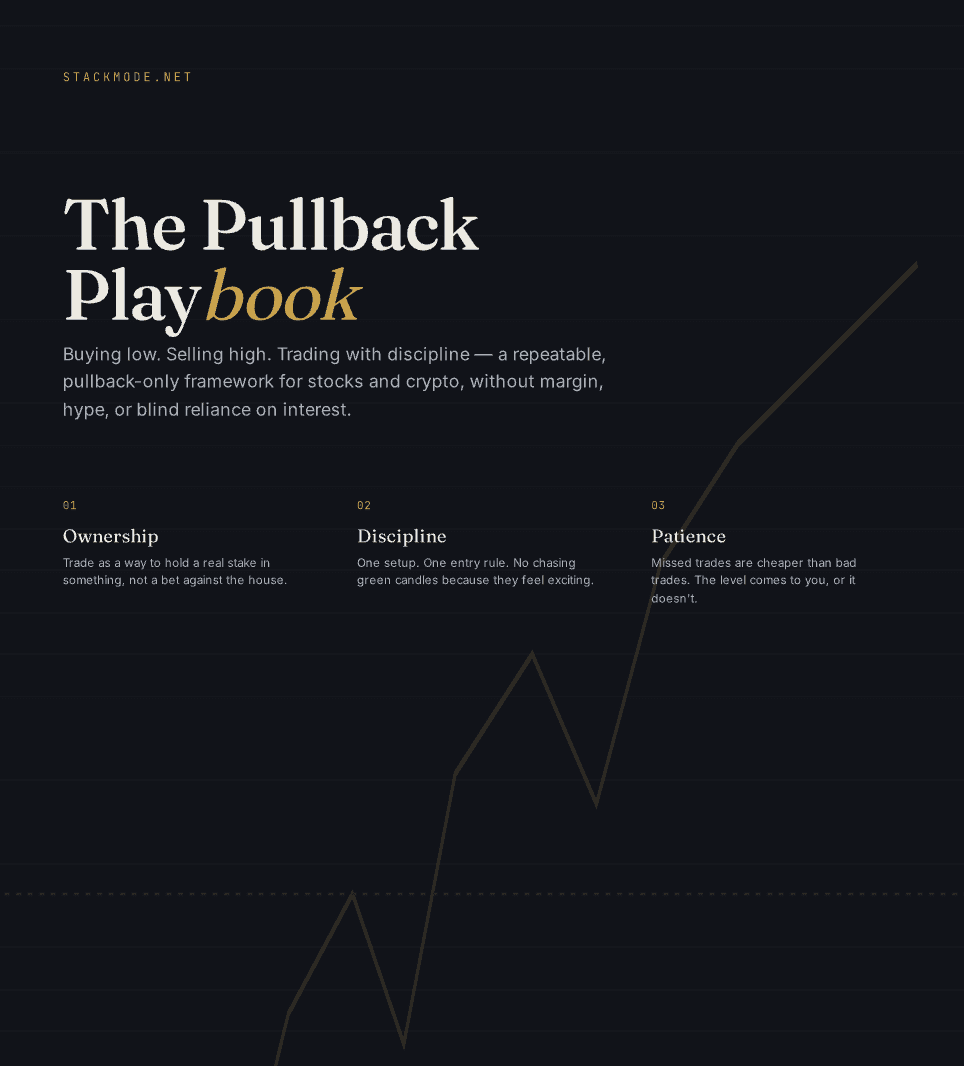
Free trading playbook
Build the plan before you place the trade.
Get the Stackmode playbook for pullbacks, risk limits, entries, exits, and trade review. It is a practical first step before you sign up for the Trading School.
- • Define the setup before entry
- • Mark invalidation and risk
- • Stop chasing moves
- • Review decisions, not just results
Opens the external Stackmode playbook page. Education only.
Trading Books
Keep Learning After The Article
Pick the book that matches the skill you want to practice next. Each one gives you a focused framework to work through after this article, with Amazon paperback and eBook options available.
Recommended starting point
Neuro Trading
Master the psychology of trading.
- Why 90% of traders lose and how to think like the 10%
- Emotional discipline techniques used by stronger traders
- A mindset framework built for long-term execution
eBook
$9.99
Paperback
$19.99
Audiobook
$9.99

Before The Hype
How to spot opportunities before they go viral.
- Learn the asset stacking strategy for long-term wealth
- Find high-signal trends before they become crowded
- Think earlier instead of chasing late momentum
eBook
$9.99
Paperback
$19.99
Audiobook
$9.99
Freedom Money
Understand Bitcoin and what it does.
- A cleaner beginner path into Bitcoin
- Protect and grow money with stronger awareness
- Build conviction before you move capital
eBook
$9.99
Paperback
$19.99
Audiobook
$9.99
Stop Blowing Your Futures Account
Pick one clean next action instead of bouncing around the site.
START HERE
Stackmode Trading School
Join the school for live classes, market review, organized lessons, StackFinder access, and member support. $499/year — StackFinder included.
Best value
StackMode Trading School
Live group sessions, stock and crypto market review, organized video lessons, StackFinder access, and a Halal spot-trading framework. $499/year.
Live class plan
Live Group Sessions Included
Bring questions, review charts, and learn the same repeatable process with students moving through the class plan together.
StackFinder
StackFinder Member Tools
AI scanner, personal watchlist, daily stock and crypto setups, dashboards, and trade-prep tools are included with the group.
Education and risk disclosure
Stackmode provides education, tools, examples, and market commentary only. Nothing on this site is personalized financial, investment, tax, or legal advice, and no result, trade recap, screenshot, testimonial, alert, or example is a promise of future performance. Trading and investing involve substantial risk of loss, including the possible loss of capital. You are responsible for your own decisions, position size, broker selection, tax treatment, and compliance with the laws and rules that apply in your location.
Read the full risk disclosure