
Join Stackmode Trading School and learn the exact multi-timeframe process we use to filter high-probability Forex setups from the noise — week after week.
Quick Answer: How To Find the Best Forex Setups
The best Forex setups in 2026 all share three elements: a clear higher-timeframe directional bias, price arriving at a high-confluence zone (where multiple technical factors agree), and a lower-timeframe entry trigger that confirms buyers or sellers have stepped in. Without all three, you are guessing — not trading.
The process starts on the Weekly or Daily chart to lock in the trend direction. Then you move to the H4 or H1 chart to watch for price to revisit a key level. Only when you see a confirming entry signal at that level do you execute the trade.
Watch the Full Guide: Best Forex Setups In 2026
In this video, I walk through the exact framework I use to identify and filter Forex setups — from the big-picture trend analysis on the Weekly chart all the way down to the entry trigger on the H1. Watch the full breakdown before reading the guide below.
What Makes a Forex Setup Valid?
Most traders fail at Forex not because they cannot read charts, but because they treat every signal on the screen as a trade opportunity. A valid setup is not just a candle pattern or a moving average crossover — it is a specific combination of conditions that puts the odds meaningfully in your favor.
A valid Forex setup requires three components working together simultaneously:
- Higher-Timeframe Trend Alignment: The overall direction of the market on the Daily or Weekly chart must support your trade direction. Trading against the dominant trend dramatically reduces your win rate.
- A High-Confluence Price Zone: Price must be approaching a level where multiple technical factors agree — prior swing highs/lows, Fibonacci retracements, supply and demand zones, or moving average confluences.
- A Confirmed Entry Trigger: A lower-timeframe candle pattern (pin bar, engulfing, inside bar) or structure shift at the zone that tells you buyers or sellers have genuinely reacted to that level.
Remove any one of these three pillars and you no longer have a setup — you have a speculation.
Multi-Timeframe Analysis: The Foundation of Every Setup
Multi-timeframe analysis (MTA) is the single most important skill in finding quality Forex setups. The concept is simple: higher timeframes tell you where the market is going; lower timeframes tell you when to enter.
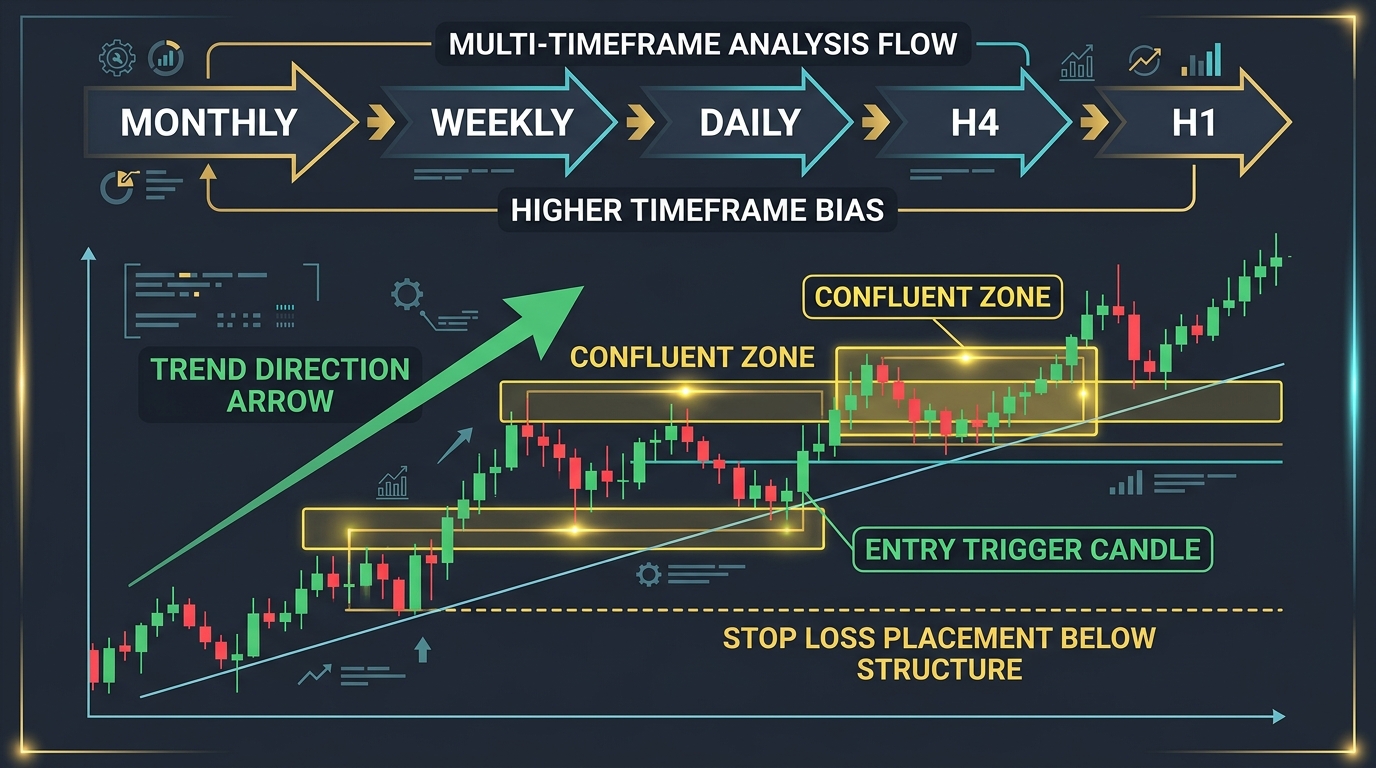
Here is the practical top-down framework:
- Monthly/Weekly Chart: Identify the macro trend. Is price in a bullish structure (higher highs and higher lows) or bearish structure? This is your primary bias. Do not fight it.
- Daily Chart: Confirm the trend and mark the key swing highs and swing lows that price has been respecting. These become your major trade zones.
- H4 Chart: This is where you get precise. Mark the supply and demand zones, Fibonacci retracement levels from recent swings, and watch for price to approach a Daily zone.
- H1 Chart: This is your entry timeframe. Wait for price to enter your marked zone and form a confirmation pattern before triggering a trade.
The mistake most beginners make is starting on the H1 and only trading what they see there. Without the higher-timeframe context, you are entering trades blindly — you have no idea whether the bigger players are positioned with you or against you.
Finding Confluence Zones: Where Smart Money Is Positioned
A confluence zone is a price area where several independent forms of analysis all point to the same level. The more factors that converge, the stronger the potential reaction when price arrives.
Common confluence factors to stack include:
- Prior Swing High or Low: Price has memory. Levels where price previously reversed are magnets for future reactions.
- Fibonacci Retracement Levels: The 38.2%, 50%, and 61.8% retracement levels frequently align with structural support and resistance. A 61.8% retracement that sits on top of a prior swing high is a powerful zone.
- Round Number Psychological Levels: Levels like 1.1000, 1.1500, or 150.00 in USD/JPY are actively watched by institutional traders and generate disproportionate reactions.
- Moving Average Convergence: When price returns to the 200 EMA on the Daily chart and that same area aligns with a prior supply or demand zone, it creates a high-probability area for a trade reaction.
- Gap Fill Zones: Institutional orders frequently cluster at the origin of prior impulse moves — these are sometimes called order blocks or fair value gaps, depending on your trading methodology.
A zone with two or three confluent factors is interesting. A zone with four or five is where you should be watching the chart very closely for a trigger candle.
Entry Triggers and Confirmation: Do Not Jump the Gun
Identifying a confluence zone is only half the work. Price arriving at a strong level does not mean you immediately enter. The entry trigger is the confirmation that the market has actually reacted to the zone — not just touched it and continued through.
Effective entry trigger signals include:
- Pin Bar (Hammer/Shooting Star): A candle with a long wick that penetrates into the zone and closes strongly back outside of it. This signals aggressive rejection of the price area.
- Bullish or Bearish Engulfing Pattern: A second candle that fully engulfs the body of the first candle in the opposite direction. At a key zone, this represents a genuine shift in momentum.
- Lower-Timeframe Structure Shift: On the H1 or M15, price breaks a prior swing high (for bullish trades) while at a Daily support zone. This confirms that the lower-timeframe trend has flipped in the direction of your trade.
- Inside Bar Breakout: A period of low-volatility consolidation within the zone followed by a directional breakout confirms that the market has absorbed selling/buying pressure and is ready to move.
The entry trigger is what separates a professional trade from a gamble. Waiting for confirmation means you will miss some moves — but the trades you do take will have a far higher probability of success.
The Forex Setup Checklist: Filter Every Trade Before You Click
Before placing any Forex trade in 2026, run through this checklist. If you cannot check all five boxes, do not take the trade.
| Checklist Item | What to Verify |
|---|---|
| ✅ Higher-TF Trend | Weekly or Daily chart shows a clear bullish or bearish structure |
| ✅ Key Zone Identified | Price is approaching a prior swing level on the Daily or H4 |
| ✅ Confluence Factors (2+) | At least two independent factors agree on the zone (e.g., swing high + Fibonacci) |
| ✅ Trigger Candle Present | A confirming entry signal has formed at the zone (pin bar, engulfing, structure shift) |
| ✅ Risk Defined Before Entry | Stop loss is placed and the risk-to-reward ratio is at minimum 1:2 before entering |
Using a checklist like this removes emotion from the decision-making process. You either have the conditions or you do not. That consistency is what separates traders who last from traders who blow up.
For more on building a disciplined trading process, read our guide on how accountability builds trading discipline.
Honest Limitations: What No Forex Setup Framework Can Guarantee
Important Limitations to Understand
- No setup has a 100% win rate. Even the cleanest multi-confluence setup with a perfect trigger candle will fail a percentage of the time. Profitability in Forex comes from positive expectancy over many trades — not from any single setup being guaranteed.
- News events can override all technical analysis. High-impact economic releases (NFP, CPI, central bank decisions) can wipe out technically valid setups in seconds. Always check the economic calendar before entering a trade.
- Spread and swap costs matter. Holding trades overnight in currencies with wide spreads or large negative swaps will erode your edge faster than you expect. Factor in trading costs when evaluating risk-to-reward.
- This is education, not financial advice. Everything in this guide is for educational purposes only. Forex trading involves significant risk of loss and is not appropriate for all investors. You should never trade money you cannot afford to lose.
FAQ: Finding Forex Setups in 2026
What is a Forex setup?
A Forex setup is a specific set of technical and structural conditions on the chart that meet your pre-defined trading criteria — including trend alignment, a key price level, and a confirmed entry trigger. Without all three elements present, it is not a valid setup.
How do you find the best Forex setups?
Start by identifying the higher-timeframe trend (Daily or Weekly chart). Then drill down to the H4 or H1 chart to find price approaching a key support or resistance zone. Wait for a confirmation candle — such as a pin bar or engulfing pattern — before entering. This process filters out the majority of low-quality trades.
What is multi-timeframe analysis in Forex?
Multi-timeframe analysis is the process of analyzing a currency pair on multiple time horizons — from the Monthly down to the H1 — to establish a clear directional bias and pinpoint high-probability entry zones. The higher timeframe sets the direction; the lower timeframe provides the precise entry.
What is a confluence zone in Forex?
A confluence zone is a price area where multiple forms of technical analysis point to the same level simultaneously — for example, a Weekly support level that also aligns with a 61.8% Fibonacci retracement and a prior swing high. The more factors that agree, the stronger the zone.
How many Forex setups should I trade per week?
Quality over quantity. Most disciplined traders take between 2 and 5 setups per week. Trading every signal that appears on the chart is one of the fastest ways to blow a trading account. Patience is a core part of any professional Forex strategy.
Is Forex trading profitable in 2026?
Forex trading can be profitable, but it is also genuinely difficult. Most retail traders lose money — studies consistently show that 70–80% of retail Forex accounts lose. Profitability requires a tested edge, disciplined risk management, and months of consistent practice. This article is educational and not financial advice.
Best-Fit Framework: What This Topic Can and Cannot Tell You
How to Find the Best Forex Setups in 2026 is best understood as an educational framework: define the decision, compare the available choices, verify current evidence, and keep the downside explicit before acting.
| Option or lens | Best for | Honest limit |
|---|---|---|
| Definition | Clarifying what the topic actually means | A definition does not predict a market outcome. |
| Process | Turning the idea into repeatable research steps | A process still depends on execution and current conditions. |
| Risk check | Sizing uncertainty and writing invalidation rules | Risk controls reduce exposure; they do not remove loss. |
Research Checklist and Related Stackmode Lessons
Use primary sources for current rules and the related Stackmode pages for connected market context. The links are learning paths, not promises that a result will transfer from one market or person to another.
Visual Study Opportunities
These are useful visual checkpoints for a future revision or companion graphic. They make the explanation easier to scan without presenting an unverified chart, number, or performance claim as proof.
- 1. A one-sentence definition card with the key term highlighted.
- 2. A labeled process diagram showing research before execution.
- 3. A comparison table with the same criteria across alternatives.
- 4. A before-and-after example that clearly labels assumptions.
- 5. A timeline showing which facts are current and which are historical.
- 6. A risk ladder from low complexity to high complexity.
- 7. A checklist for source, date, cost, liquidity, and invalidation.
- 8. A worked example using hypothetical values rather than a promise.
- 9. A common-mistakes graphic with the correction beside each mistake.
- 10. A final decision tree showing when to pause and verify more evidence.
Expanded FAQ
What is the main idea of this article?
The main idea is to understand how to find the best forex setups in 2026 as a process with defined assumptions, risks, and verification steps rather than as a guaranteed outcome.
Who is this article for?
It is for readers who want an educational framework before making a market, trading, or investing decision.
What should a beginner do first?
Start with the definition, identify the instrument or market involved, and write down the risk before thinking about an entry or action.
What information should be verified?
Verify the product rules, current data, costs, timing, liquidity, source date, and any claim that could change the decision.
What is the biggest mistake to avoid?
The biggest mistake is treating an educational explanation as a promise and skipping independent risk checks.
How does risk management fit in?
Risk management sets the position size, invalidation point, maximum loss, and review process before execution.
Can this approach guarantee a profit?
No. Markets are uncertain, and no framework can guarantee a profit or remove loss risk.
How current is this information?
Market rules, prices, products, and policy can change, so check the dated primary source before acting.
Should this replace professional advice?
No. It is general education, not personalized financial, tax, legal, or investment advice.
How should readers compare alternatives?
Compare the same criteria: purpose, issuer, liquidity, costs, volatility, custody, time horizon, and honest limitations.
What should be written in a trading plan?
Record the thesis, setup, entry condition, invalidation, size, maximum loss, exit logic, and review date.
Why do source dates matter?
A dated source shows when a rule, number, or statement was true and helps expose stale or unsupported claims.
How can readers reduce confirmation bias?
Write what would disprove the thesis, review opposing evidence, and avoid relying on one headline or one chart.
What is a sensible next step?
Use the article as a checklist, verify the primary sources, and practice with risk that is small enough to survive mistakes.
Conclusion: Use the Framework, Then Verify the Decision
How to Find the Best Forex Setups in 2026 is best understood as an educational framework: define the decision, compare the available choices, verify current evidence, and keep the downside explicit before acting. The useful takeaway is not a prediction. It is a repeatable process: define the topic, compare the available choices, verify current sources, size risk conservatively, and record what would change your mind.
Stackmode provides educational market context, not guaranteed returns or personalized financial advice. Recheck current rules, prices, liquidity, and tax implications before acting.
Free trading playbook
Build the plan before you place the trade.
Get the Stackmode playbook for pullbacks, risk limits, entries, exits, and trade review. It is a practical first step before you sign up for the Trading School.
- • Define the setup before entry
- • Mark invalidation and risk
- • Stop chasing moves
- • Review decisions, not just results
Opens the external Stackmode playbook page. Education only.
Trading Books
Keep Learning After The Article
Pick the book that matches the skill you want to practice next. Each one gives you a focused framework to work through after this article, with Amazon paperback and eBook options available.
Recommended starting point
Neuro Trading
Master the psychology of trading.
- Why 90% of traders lose and how to think like the 10%
- Emotional discipline techniques used by stronger traders
- A mindset framework built for long-term execution
eBook
$9.99
Paperback
$19.99
Audiobook
$9.99
Before The Hype
How to spot opportunities before they go viral.
- Learn the asset stacking strategy for long-term wealth
- Find high-signal trends before they become crowded
- Think earlier instead of chasing late momentum
eBook
$9.99
Paperback
$19.99
Audiobook
$9.99

Freedom Money
Understand Bitcoin and what it does.
- A cleaner beginner path into Bitcoin
- Protect and grow money with stronger awareness
- Build conviction before you move capital
eBook
$9.99
Paperback
$19.99
Audiobook
$9.99
Ready to Find Better Setups?
Pick one clean next action instead of bouncing around the site.
START HERE
Stackmode Trading School
Join the school for live classes, market review, organized lessons, StackFinder access, and member support. $499/year — StackFinder included.
Best value
StackMode Trading School
Live group sessions, stock and crypto market review, organized video lessons, StackFinder access, and a Halal spot-trading framework. $499/year.
Live class plan
Live Group Sessions Included
Bring questions, review charts, and learn the same repeatable process with students moving through the class plan together.
StackFinder
StackFinder Member Tools
AI scanner, personal watchlist, daily stock and crypto setups, dashboards, and trade-prep tools are included with the group.
Education and risk disclosure
Stackmode provides education, tools, examples, and market commentary only. Nothing on this site is personalized financial, investment, tax, or legal advice, and no result, trade recap, screenshot, testimonial, alert, or example is a promise of future performance. Trading and investing involve substantial risk of loss, including the possible loss of capital. You are responsible for your own decisions, position size, broker selection, tax treatment, and compliance with the laws and rules that apply in your location.
Read the full risk disclosure